Automation of Double Pulse Test (DPT) & Data Acquisition
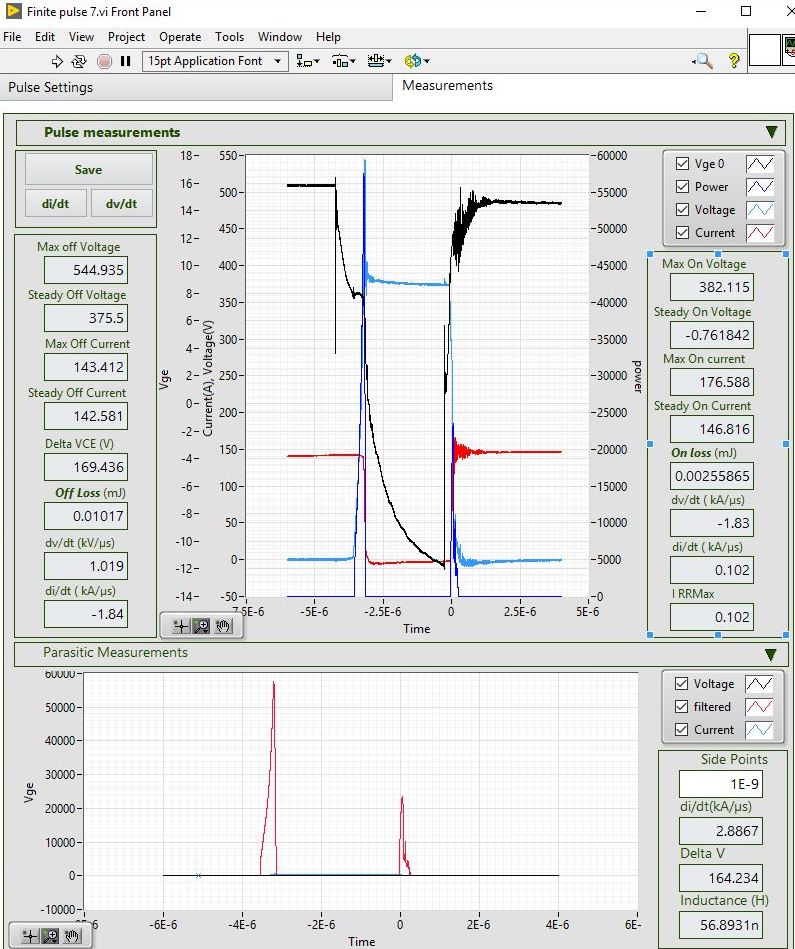
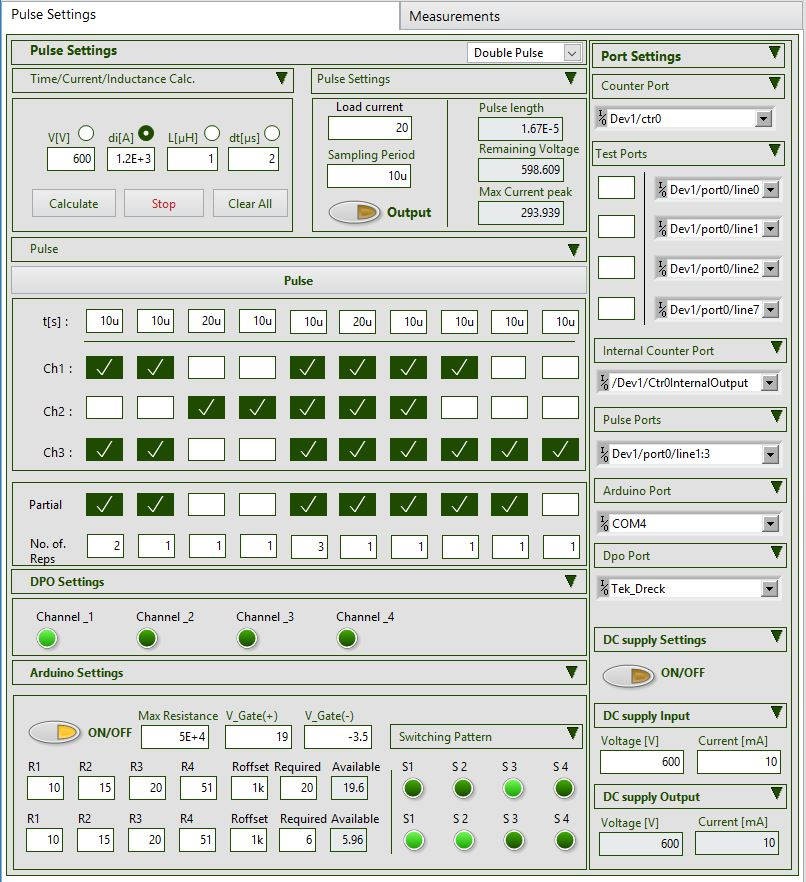
I automated a high-precision test setup for Double Pulse Testing (DPT), a critical procedure for analyzing switching losses and parasitic inductance in power semiconductors using LabVIEW. My work focused on replacing time-consuming manual measurements with a sophisticated software-driven approach.
Introduction to Double Pulse Testing (DPT)
Double Pulse Testing is the industry-standard method for evaluating the dynamic switching characteristics of power semiconductor devices, such as IGBTs and MOSFETs. By applying two precisely timed pulses to the device under test (DUT) within an inductive load circuit, engineers can measure critical parameters including switching losses ($E_{on}$ and $E_{off}$), reverse recovery, and parasitic inductances. This testing is essential for ensuring the efficiency and reliability of power converters used in electric vehicles and industrial motor drives.
LabVIEW Automation
In modern power electronics laboratories, manual data acquisition from oscilloscopes and high-voltage probes is often slow and prone to human error. LabVIEW Automation transforms this process by creating a unified software interface that controls the signal generator, captures high-speed waveforms, and performs real-time mathematical analysis.
For my project, I utilized Object-Oriented Programming (OOP) in LabVIEW to build a modular system that:
- Automated the Workflow: Reduced data acquisition time from 10 minutes to just 20 seconds, a 95% increase in efficiency.
- Enhanced Precision: Implemented digital filters (like Savitzky-Golay) to process noise and achieved a correlation criterion of less than 11% compared to manual benchmark values.
- Controlled Hardware: Managed digital potentiometers via SPI communication to precisely tune gate resistance using the voltage dividing rule in ARDUINO UNO